Translate

Showing posts with label calligraphy. Show all posts

Thursday, September 7, 2023

Calligraphy On Sichuan Silk


This is The Travelling Through Brush and Ink video series selects the most important painting and calligraphic works in the National Palace Museum’s collection.


_______________________________________________

You May Also Like


Learn Chinese with Fun Games


Thursday, August 23, 2018

Calligraphy Teaching by Mr. Wang Xinghua


Mr. Wang Xinghua's calligraphy teaching

王興華老師書法教學杜甫江畔獨步尋花


_________________________________________________________


Monday, September 29, 2014

Chinese Calligraphy Lessons


Here are calligraphy lessons from Ling Chi and Ja Shin:

OAS Chinese Calligraphy lesson 3


OAS Chinese Calligraphy lesson 1


Beautiful Calligraphy

Beautiful calligraphy arts by 劉方平

行書 劉方平 月夜
書法_行書_劉方平_月夜


Poems in Cursive Script (《草书诗帖》)


You might also like:

Poem by Du Mu, Tang's Poet 


______________________________________________________________________


Friday, January 10, 2014

Chen Shidao's Poem - 十七日觀潮


Chen Shidao (陳師道, 1053-1101) was known for both his prose and his poetry, studying under Huang Tingjian and modelling his poetry on that of Du Fu. Both Su Shi and Zhu Xi admired his writings. 


Below is a calligraphy of one of his poems, 十七日觀潮:


十七日觀潮  ·陳師道   

漫漫平沙走白虹,
瑤台失手玉杯空。
晴天搖動清江底,
晚日浮沉急浪中。

潮頭初出海門山,
千裏平沙轉麵間。
猶有江神憐北客,
欲將奇觀破衰顏。

________________________________________________________________________


Watch Chinese Calligraphy Video Tutorial

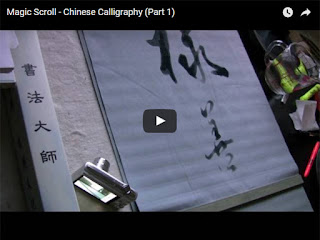
 Magic Scroll - Chinese Calligraphy


Wednesday, January 8, 2014

Tao Calligraphy Symbol


Tao or Dao (Chinese: 道), is a Chinese concept
signifying 'way', 'path', or sometimes more loosely, 
''doctrine' or 'principle', or as a verb, speak.
Taoism is a philosophical and religious tradition that
emphasizes living in harmony with the Tao.
In Taoism, however, Tao denotes something that is both
the source and the driving force behind everything that exists.


Calligraphy_0039 by V. Ong


______________________________________________________________


Poem by
He Zhizhang


Saturday, January 4, 2014

Calligraphy of Poems by Li Bai


Calligraphy of poems written by one of Tang Dynasty famous poet, Li Bai.


望天門山  【唐】 李白

天門中斷楚江開,

碧水東流至此回。
兩岸青山相對出,

孤帆一片日邊來。


送孟浩然之廣陵   【唐】 李白

故人西辭黃鶴樓,
煙花三月下揚州。
孤帆遠影碧空盡,
惟見長江天際流。


 Calligraphy_9118


Calligraphy_9125 


Li Bai (Li Pai; Chinese: 李白; pinyin: Lǐ Bái; Wade–Giles: Li3 Pai2, 701[1] – 762), also known as Li Bo (or Li Po; pinyin: Lǐ Bó; Wade–Giles: Li3 Po2), is a Chinese poet acclaimed from his own day to the present as a genius and romantic figure who took traditional poetic forms to new heights. He and his friend Du Fu (712-770) are the two most prominent figures in the flourishing of Chinese poetry in the mid-Tang Dynasty that is often called the "Golden Age of China." Wikipedia

More Li Bai's poem.

______________________________________________________


Calligraphy of Poem by Wang Changling


A calligraphy writing Mr. Wang of a poem by Chinese poet, Wang Changling during Tang Dynasty:


芙蓉樓送辛漸   【唐】王昌齡

寒雨連江夜入吳,
平明送客楚山孤。
洛陽親友如相問,
一片冰心在玉壺


Calligraphy_9121


Wang Changling (王昌齡; pinyin: Wáng Chānglíng) (698–756) was a major Tang Dynasty poet. He was originally from Taiyuan in the Shanxi province of China. After passing the prestigious jinshi examination, he became a secretarial official and later held other imperial positions,  

Later in his life, he was appointed as a minister of Jiangning county. He is best known for his poems describing battles in the frontier regions of western China. Wang Changling was one of the competitors in the famous wine shop competition along with Gao Shi and Wang Zhihuan.


_______________________________________________________________________


Calligraphy Arts
by 劉方平

Music Technique -
Five Finger Exercise

Calligraphy Arts
by Hu Yaohuang

Monday, December 30, 2013

Calligraphy #8 - Poem by Yang Wanli


A calligraphy writing of Wang Suvit of a poem written by
Yang Wanli (or Yang Wan-Li, 楊萬里; 1127–1206) who was 
Chinese poet, born in Jiangxi. 
He was one of the "four masters" of Song Dynasty poetry.


Written during the final exile of the Song to Hangzhou, 
Yang Wanli's poems celebrate the beauties and
mysteries of nature, flora and fauna, much as the famed Song painters did. 
But they also querulously and wittily illuminate the annoyances and
pleasures of everyday life. Wikipedia.org


Calligraphy_9105


小池 【宋】楊萬里

泉眼無聲惜細流,
樹陰照水愛晴柔。
小荷才露尖尖角,
早有蜻蜓立上頭。


____________________________

Read more of Yang Wanli's poems

Ancient Chinese Musical Instruments, Classical Tunes Vol. 1

Poem by He Zhizhang

 Poem by He Zhizhang


Calligraphy #7 - Poem by Wang Wei

Calligraphy_9103


渭城曲  【唐】王維
渭城朝雨浥輕塵,客舍青青柳色新。
勸君更盡一盃酒,西出陽關無故人。


Poem written by Wang Wei (traditional Chinese: 王維)(699-759) and also known by other names such as Wang Youcheng, was a Tang Dynasty Chinese poet, musician, painter, and statesman. He was one of the most famous men of arts and letters of his time. Many of his poems are preserved, and twenty-nine were included in the highly influential 18th century anthology Three Hundred Tang Poems. Wikipedia.org


_________________________________________

More poems of Wang Wei
王之道 - 五言律诗联
Read more poems


 Chinese Calligraphy Art

Calligraphy #6 - Poem by Gao Shi


A poem written by Gao Shi (Chinese: 高適; 704–765), was a poet of the Tang Dynasty.


Calligraphy_9113


Calligraphy_9110


別董大  【唐】高適

千里黃雲白日曛,
北風吹雁雪紛紛。
莫愁前路無知己,
天下誰人不識君?


Gao Shi's poems were collected in the popular anthology Three Hundred Tang Poems. Born into an impoverished family in Hunan Province, Gao eventually became a secretary in the military, enjoying a successful career. Gao Shi was one of the competitors in the famous wine shop competition along with Wang Zhihuan and Wang Changling.  ( Wikipedia)


_____________________________________________________
See more of 高適 poems


Calligraphy #4 - Poem by Du Mu


A poem, 山行, written by Du Mu

Calligraphy_9095 writing by Wang Suvit


山行  【唐】杜牧

遠上寒山石徑斜,白雲生處有人家。
停車坐愛楓林晚,霜葉紅於二月花。


Du Mu (Chinese: 杜牧; pinyin: Dù Mù; Wade–Giles: Tu4 Mu4) (803–852) was a leading Chinese poet of the late Tang Dynasty. His courtesy name was Muzhi (牧之), and sobriquet Fanchuan (樊川). Regarded as a major poet during a golden age of Chinese poetry, his name is often mentioned along with that of another renowned Late Tang poet, Li Shangyin, as the Little Li-Du (小李杜), in contrast to the Great Li-Du: Li Bai and Du Fu. Among his influences were Du Fu, Li Bai, Han Yu and Liu Zongyuan. Wikipedia.org


________________________________

You May Also Like


Learn Chinese with Fun Games


Poem by Zhang Zhihe


Calligraphy #3 - Poem by Liu Yuxi


Calligraphy of a poem, 浪淘沙九首, by Chinese poet, Liu Yuxi.


Calligraphy_9082 by Suvit Ong

浪淘沙九首   【唐】劉禹錫

九曲黃河萬里沙,
浪淘風簸自天涯。
如今直上銀河去,
同到牽牛織女家。


Liu Yuxi (traditional Chinese: 劉禹錫; pinyin: Liú Yǔxī) (772–842) was a Chinese poet, philosopher, and essayist, active during the Tang Dynasty. He was an associate of Bai Juyi and was known for his folk-style poems. Most famously, he is known for his poem Lou Shi Ming 陋室銘, "Inscription of a crude house". It describes living in a simple dwelling, following a life that is rich in character, refined in culture and learning.  Wikipedia.org

(唐詩宋詞/劉禹錫)


_____________________________________________________


Calligraphy Arts
by 劉方平


Calligraphy Arts
by Hu Yaohuang


Calligraphy #2 - Poem by He Zhizhang


Calligraphy of a well-known poem, On Returning Home, written by He Zhizhang
(traditional Chinese: 賀知章; 659–744).
He Zhizhang's courtesy name Jizhen (季真), and was a
Chinese poet born in present-day Xiaoshan in Zhejiang during the 
Tang Dynasty, and is one of the Eight Immortals of 
the Wine Cup. Wikipedia.org 


Calligraphy_9087 by Wang Suvit


回鄉偶書二首 【唐】賀知章

少小離家老大回,
鄉音無改鬢毛衰。
兒童相見不相識,
笑問客從何處來。

離別家鄉歲月多,
近來人事半消磨。
惟有門前鏡湖水,
春風不改舊時波。

Translations:


On Returning Home


Young when he left home to become a man when returning home, 

although there is no change in the local accent, but there are sparse hair graying temples.
Met the children but we don't know each other,
they treated me like a guest, smiled and asked me where I came from.

Parting home has been for a long time, 

to go home after that great changes have taken place in the hometown.
Only in front of the Mirror Lake's clear water,
in the spring breeze, that still look like in the old days.


__________________________________


See more of 賀知章 poem and translations


Calligraphy of Liu Yuxi's Poem


Learning by Songs- Learn to Count 1 to 10


Chinese Calligraphy Art


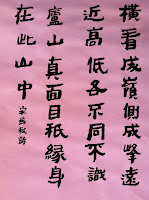
Calligraphy of a poem by Chinese poet, Su Shi.


Calligraphy_9085

题西林壁 【宋蘇軾

橫看成嶺側成峰,
遠近高低各不同。
不識廬山真面目,
只緣身在此山中。


Su Shi (蘇軾, also known as Su Dong Po (1037 – 1101) was a Chinese writer, poet, painter, calligrapher, pharmacologist, gastronome, and a statesman of the Song Dynasty (960–1279). A major personality of the Song era, Su Shi was famed as an essayist, and his prose writings lucidly contribute to the understanding of topics such as 11th-century Chinese travel literature or detailed information on the contemporary Chinese iron industry.

His poetry has a long history of popularity and influence in China, Japan, and other areas in the near vicinity; and, his poetry is well known in the English speaking parts of the world through the translations by Arthur Waley, among others.  Wikipedia: Su Shi


Read more of Su Shi's poems

__________________________________________________________________________


  Learning Piano for Free